My first Garden Bloggers’ Bloom Day of 2025.
I’m going to try to resurrect creating separate posts for Garden Blogger’s Bloom Day from May to October, though I include garden blooms in my weekly Liminal Living posts as well. It would be nice, for me and maybe others, to be able to see just what’s blooming each month without wading through a lot of other details that are included in those posts.
SHRUBS & TREES
The showstopper so far in May is certainly the ‘Olga Mezitt’ rhododendron, officially “Rhododendron × ‘Olga Mezitt’ (P.J.M. Hybrid Group).” We planted two of them together in 2010 and this year, 15 years on, the bloom is the best it’s ever been, so lush and plush.


As noted in my 2023 May GBBD post, the Pieris japonica (andromeda) is [still] blooming its little heart out, and the bumblebees love it.


We planted the weeping ‘Red Jade’ crabapple in 2010 and have been pruning it quite a lot in recent years. Its bloom has always been profuse and sweetly scented (another one the bumblebees love).


The sand cherry (Prunus pumila) just bloomed this week. It’s also called the dwarf sand plum and it’s native to NH.


I bought spicebushes (Lindera benzoin) mainly to lure spicebush swallowtail caterpillars to the yard and also for the berries but apparently I have only five female plants and no males, so none of those pretty red fruits for me. And so far (seven years) no caterpillars. Still, these little flowers (in rain) are pretty.

The lilacs are starting to bloom here; hoping for no late frosts.


The peach trees (semi-dwarf Red Haven variety planted in 2011) flowered!

🍃🍃🍃
PERENNIALS
Epimediums
This white-with-red epimedium (from a plant sale in 2021, species/cultivar not known) has been blooming all month. It’s delicate and easy to miss. According to Wikispecies, there are 67 species of Epimedium, which is also called barrenwort, bishop’s hat, and the name I may have to use from now on, Rowdy Lamb Herb. Epimedium: Queens of the Woodland is fantastic resource and inspiration to find and plant more epimedium species and cultivars, of which there are many.


Bedrock Gardens in Lee, NH, is a great place to look at many of them, and it’s where I first saw the evergreen Epimedium wushanense ‘Sandy Claws’, which I was able to add to the garden about three years ago. It’s just started blooming, a yellow-white flower (this one covered in raindrops).


And in another part of the garden, a very pale pink epimedium, also from a plant sale and also species/cultivar unknown.


Spring Bush Pea (Lathyrus vernus) is a great early bloomer that spreads nicely. It’s in my front yard and in the shade garden, where it has replanted itself in a few spots.


Blue cohosh (Caulophyllum thalictroides), with one of the most striking little flowers ever, is native in most of New England — but not in my county!

Amsonia tabernaemontana (Eastern Bluestar) is a pretty carefree perennial, and it sometimes spreads (nicely). I’ve planted them all over the yard. This one just started blooming a day or two ago.


I bought a Brunnera macrophylla ‘Jack Frost’ 12 years ago, and it’s lost almost all its variegation but it still blooms beautifully. It’s commonly called Siberian bugloss and also sometimes false forget-me-not, and you can see why when you look at the flowers, which bloom at the same time here each year as the real forget-me-nots.


Euphorbia epithymoides ‘First Blush’ is known for its yellow and green flower bracts that crown its pink, green, and cream foliage. As with other plants that have variegated foliage, this one has lost most of its variegation over the years. It’s still a showoff.

Tiarella cordifolia (foamflower), native to New England and rather spready with it. I bought a ‘Spring Symphony’ and then a couple of unknown varieties at a plant sale, all in 2011, and now I have more than a dozen plants. It’s just starting to bloom, a light pink.

Woodland Phlox (Phlox divaricata), a native ground cover, is blooming now in several spots in the garden. I’m hoping it spreads “slowly but steadily” as I was told when I bought the plants (two in 2020 and another in 2022).


🍃🍃🍃
ANNUALS/BULBS
These Fritillaria meleagris (snake’s-head lily, checkered lily), planted a few years ago, rebloomed in April into early May. I love every kind of fritillaria but the large orange bulbs (F. imperialis) never bloom or even emerge from the ground for me, and the bulbs are expensive, so I stick with these and the tiny F. uva vulpis (fox’s grape fritillary). (If you want to know all the things about fritillaria, check out Wikipedia’s very weedy page on the genus.)

The daffodils are cheery and reliable.

Just when the daffs are finishing up, the equally cheery parrot tulips are now budding and blooming.


🍃🍃🍃
A FEW OTHERS
The Trillium luteum (yellow trillium) has emerged with buds for its 8th year!

Jack-in-the-pulpits (Arisaema triphyllum), which are a native woodland plant, come up in at least two places in the yard (rock wall and front island), and when I checked yesterday there were three blooming plants in the rock wall.


Canadian wild ginger (Asarum canadense) has inconspicuous pink-red flowers, held at ground level. You have to dig a little to find them.


Finally, a wild dwarf ginseng found in the lawn recently. I’ve seen them in the woods but have never planted one.

Hope to see you again in mid-June.
Check out other gardeners’ blooms at Garden Bloggers’ Bloom Day, hosted by Carol at May Dreams Gardens. (She’s in USDA hardiness zone 6a in Indiana and I’m in zone 5a in New Hampshire.)
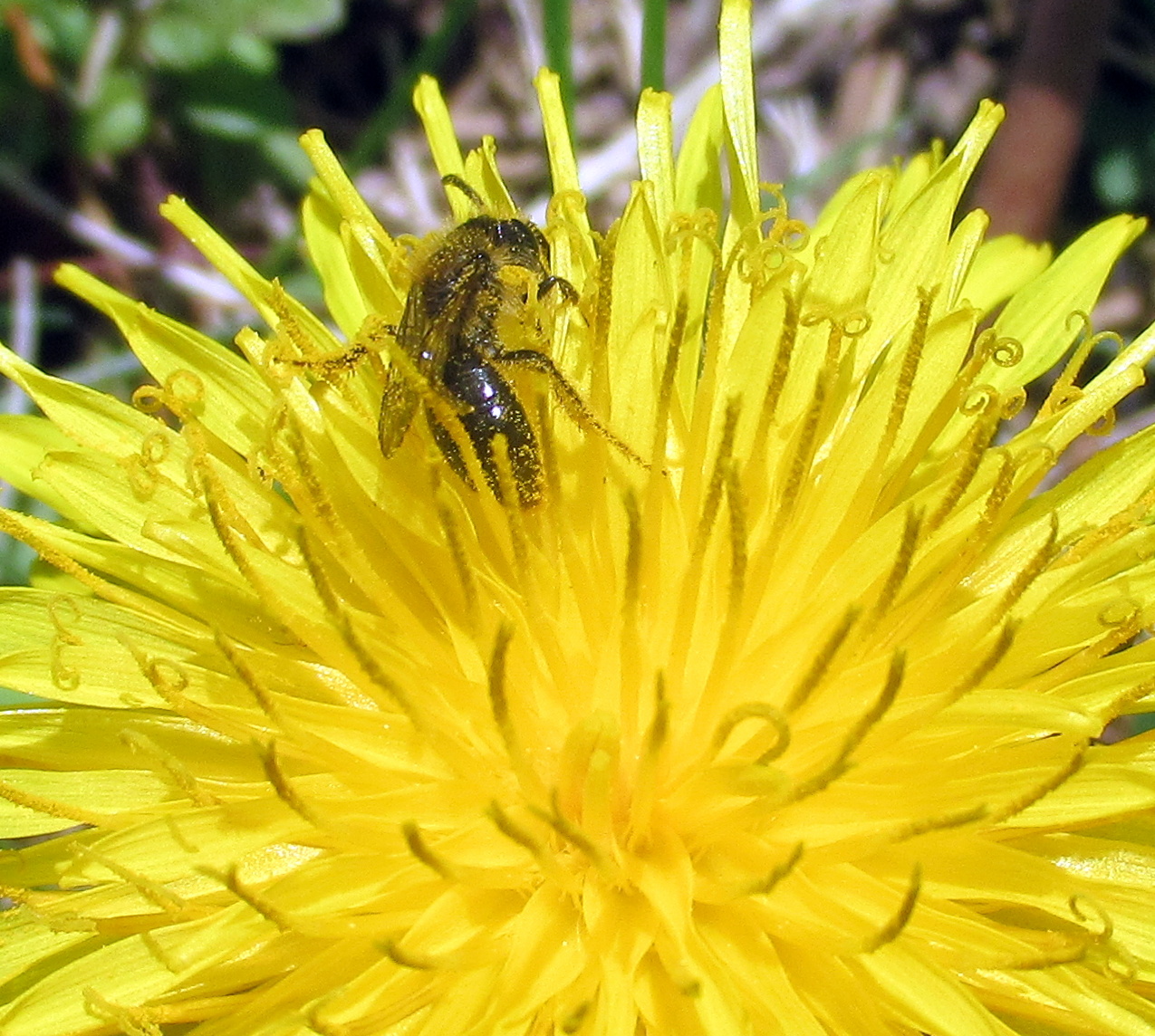
Featured image is a mining bee in a dandelion.

Leave a Reply